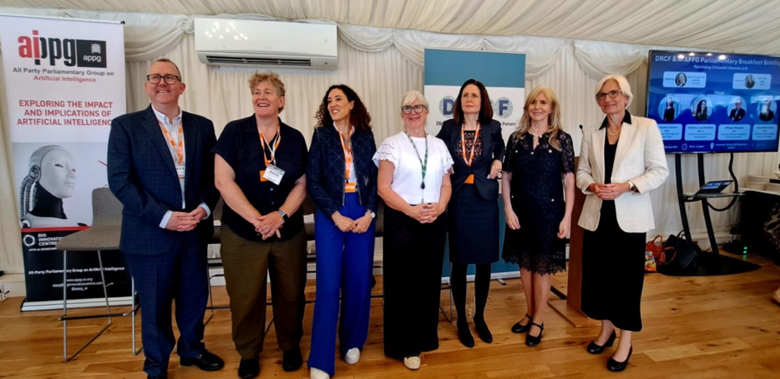

Artificial intelligence is rapidly becoming part of everyday life, influencing how consumers access services, manage finances, find information and interact with businesses. Amid ongoing plans from Government to support and scale AI adoption, the DRCF cohosted a Parliamentary Breakfast with the AI All Party Parliamentary Group (APPG) in June, to discuss their work maximising consumer interests, while supporting the Government’s ambitions to harness the power of AI to support growth.
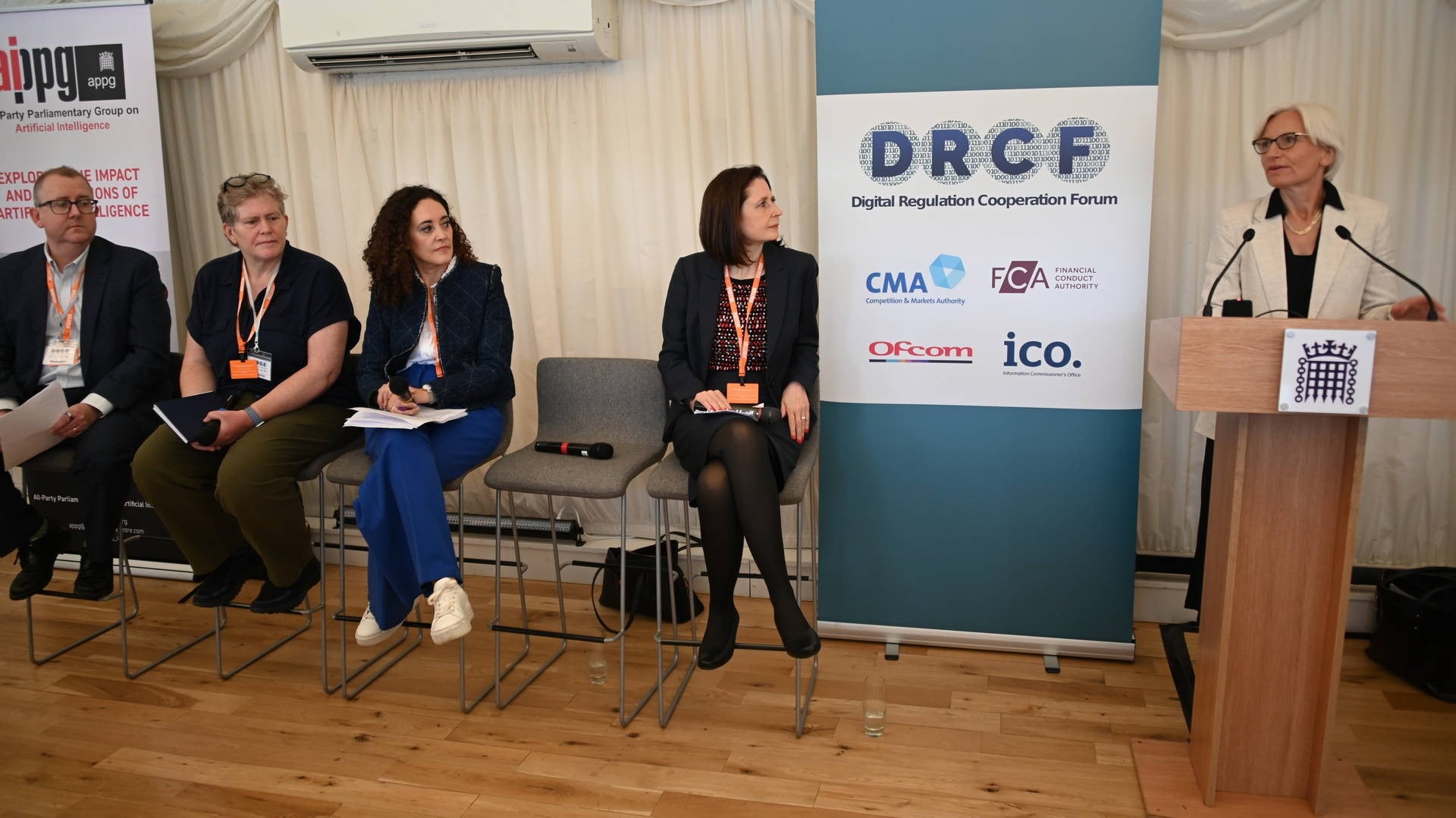
The discussion brought together senior representatives from the Digital Regulation Cooperation Forum and member regulators, the Competition and Markets Authority (CMA), Ofcom, the Financial Conduct Authority (FCA), and the Information Commissioner’s Office (ICO), highlighting the importance of coordinated regulatory approaches as AI advances. With an audience of industry experts, parliamentarians, civil society and academia, we looked at the key issues facing consumers today and discussed how regulation can ensure consumer interests are protected and promoted.
Key Takeaways
A number of themes emerged from the discussion:
· Trust: Building consumer trust is fundamental to successful AI adoption.
· Established frameworks: Existing regulatory frameworks already provide important safeguards across many AI use cases.
· Supporting Innovation: Smart, proportionate regulation will support both innovation and growth.
· Governance & Responsibility: Businesses should build compliance, fairness, safety, and transparency into AI systems from the outset.
· Cooperation: Regulatory cooperation is essential to ensure consistency and coherence across sectors.
· Future-proofing: Building a system which anticipates future risks is just as important as responding to harms that emerge todayAI governance and consumer trust.
Opening the event, Kate Jones, CEO of the DRCF, underlined the importance of a sector-by-sector approach to AI, while ensuring coherence and clarity across the regulatory landscape through the DRCF’s role as a conduit between different areas of digital regulation. Our aim is to maximise consumer interests in AI, recognising the benefits to the UK while ensuring the governance framework is fit for purpose.
Allison Gardner MP, co-chair of the AI APPG, described AI governance as one of the defining policy challenges of our time.
While acknowledging AI is enabling rapid innovation and accelerating the development of new products and services, Allison noted that consumer adoption cannot be taken for granted. Building trust in these services will be essential if consumers are to realise its benefits and incorporate new tech into their lives. It was stressed how effective regulation is a key tool in the innovation piece, particularly given the speed at which new products are being brought to market.
Supporting innovation while maintaining safeguards
Building on Allison’s earlier comments, a recurring theme throughout the panel discussion was that innovation and regulation should not be viewed as opposing forces. Panel members explained how well-designed regulation can provide more certainty and confidence to encourage consumer adoption and support industry investment.
Charlotte Clark, Director of Cross Cutting Policy and Strategy at the FCA, highlighted the opportunities AI is bringing to financial services, explaining that the FCA’s existing regulatory framework already provides mechanisms to oversee responsible AI deployment.
As a tool, AI can be used to make firms more efficient, but organisations must ensure it’s used effectively and responsibly. Rather than creating AI-specific regulations, the FCA focuses on outcomes, accountability, and adequate consumer protection which can be delivered through established frameworks like the Consumer Duty.
Similarly, Cristina Luna-Esteban, Director of Consumers and Retail Markets at Ofcom, emphasised that AI applications and associated risks vary significantly across sectors. While Ofcom stands ready to use existing powers where necessary, its objective is to support the safe and beneficial adoption of AI technologies, as well as regulating risk.
Designing trustworthy AI
Consumer trust emerged as one of the most important themes across the morning’s discussion. William Malcolm, Executive Director of Regulatory Risk and Innovation at the ICO, highlighted the regulators’ work on AI and biometric technologies, noting recent guidance on automated decision-making and AI-enabled recruitment tools. He argued product design considerations should be addressed at early stages of development, rather than after the systems have been deployed.
This point was echoed by Karen Croxson, Chief Data, Technology and Insight Officer at the CMA, who highlighted the growing importance of agentic AI and the opportunities it presents for consumers. Future AI assistants may help people manage their finances, compare services, and complete transactions on their behalf.
However, Karen stressed that these opportunities will only be realised if consumers trust AI systems are acting in their interests. This raises important questions about reliability, transparency, data use, and oversight. The CMA has published recent thinking on agentic AI alongside practical guidance for businesses. She noted that using AI does not change legal obligations – consumer and competition law continue to apply and businesses remain responsible for what their AI agents say and do. Businesses, she suggested, should ensure compliance, fairness and safety are incorporated by design, supported by appropriate human oversight and ongoing monitoring.
AI and the future consumer experience
The panel also explored how AI is beginning to reshape consumer interactions across the member regulators sectors.
In telecommunications, Cristina discussed how many providers already use rule-based chatbots, noting that these can often result in poor customer experiences. Providers are increasingly exploring more advanced generative AI capabilities, while comparison and intermediary services are also embedding AI-driven assistance into customer journeys. Later this year, Ofcom will publish research on consumer impacts of AI in the telecoms sector to better understand customers’ and SMEs’ experiences, and the potential benefits and risks.
Looking ahead, the use of AI agents will increase across the consumer journey. While these developments could reduce friction and improve convenience, they also raise important technical regulatory and consumer protection questions. The DRCF is currently exploring consumer attitudes towards generative and agentic AI adoption, as well as the tools and frameworks available to policy makers, regulators, industry and consumers, to manage risks effectively without undue restriction on AI opportunities.
Cristina reiterated how consumer trust in products and infrastructure remains particularly important in this context, given concerns about AI-enabled scams, deepfakes, misinformation, fraud, and cyber threats. As AI capabilities evolve, ensuring the security and resilience of the digital ecosystem will remain a key priority.
Preparing for agentic AI in financial services
The discussion also examined the implications of AI-driven decision-making in financial services. Charlotte highlighted emerging debates around agentic payments and the possibility of consumers delegating increasing levels of authority to AI systems.
As reliance on AI-driven services increases, regulators and firms will need to consider how existing protections apply and whether new approaches are required to safeguard consumers without constraining beneficial innovation. With AI expected to reshape the financial services sector by 2030, as highlighted in the recent Mills Review, the FCA is considering how to strengthen consumer outcomes and prepare for more agentic forms of interaction.

Anticipating future harms
Panelists agreed regulatory approaches should not only respond to existing risks but anticipate future challenges.
Karen reflected that the CMA has been working for many years on algorithms, including early work on algorithmic pricing as well as on wider risks and opportunities, and in-depth reports on AI Foundation Models. AI and Collusion is another area of focus. The CMA continues to monitor and assess emerging technology and infuse this insight across the breadth of its work, supporting everything from early risk identification through to guidance for businesses, evidence, enforcement and remedy design. It works proactively across the ecosystem including internationally to share insight and support positive outcomes.
William highlighted the ICO’s focus on identifying emerging harms, improving engagement with consumers, and ensuring data protection rights remain effective in an increasingly AI-enabling environment. While he cautioned against creating unnecessary compliance burdens, he also warned against a “rush to market” mentality.
The challenge, he suggested, is finding the right balance: enabling innovation to move at pace while maintaining good judgement and appropriate safeguards to protect consumers.
Regulatory capability and collaboration
The panel also touched on steps regulators are taking to adapt to the AI era.
Karen explained how the CMA has invested in its analytical capabilities and is using AI tools internally to identify potential consumer harms at scale. Such approaches can help regulators act more quickly and efficiently, including through early interventions where formal enforcement action may not be required.
Panelists also emphasised the importance of collaboration between regulators, industry, consumer groups, and government. During the audience Q&A, speakers repeated the idea that AI governance is a shared challenge requiring both domestic and international cooperation, which is championed through the DRCF’s collaborative model and International Network for Digital Regulation Cooperation (INDRC).
Looking ahead
Closing the event, Professor Birgitte Andersen, Secretariat of the AI APPG, reiterated that consumer trust should be viewed as an enabler of innovation. As AI becomes increasingly embedded across the economy, the question is no longer whether adoption will occur, but how to maximise the benefits for consumers while maintaining confidence in the technology.
This panel discussion highlighted the broad agreement across regulators that achieving this balance will require ongoing engagement, effective governance, and a commitment to designing trustworthy AI from the outset. Ultimately, the discussion reinforced that trust and innovation are mutually reinforcing, rather than competing objectives.
If you would like to hear more about the work of the DRCF and member regulators, please get in touch with us at DRCF@ofcom.org.uk or follow us on LinkedIn.