
On 10th March, the DRCF hosted its second annual Responsible AI Forum. With over 30 expert speakers and 200+ representatives from regulators, industry leaders, academics, civil society and public sector practitioners, the Forum provided a space for timely conversation about how AI technologies are reshaping the regulatory landscape.
With AI being developed at great pace, the Forum offered an important moment to pause, take stock, and reflect on the current and future landscape. It also provided a platform to highlight the work our member regulators are doing to champion responsible innovation - innovation that supports economic growth while ensuring users, markets and society are protected from harm.
Across eight panels and a provocative keynote from Kenneth Cukier, Deputy Executive Editor at the Economist, our participants got to grips with topics such as AI governance, advances in agentic AI, public sector AI adoption, consumer protection and AI and the risks and benefits for children growing up with chatbots.
Two of our DRCF workstreams showcased key contributions at the Forum. The Thematic Hub and the Horizon Scanning & Emerging Technologies team (HSET) presented significant pieces of work on agentic AI: the ICO’s Tech Futures report and HSET’s forthcoming discussion paper on agentic AI. Insights from these helped deepen our shared understanding of the opportunities and risks associated with increasingly autonomous AI systems.
We’ve set out four key takeaways from the Forum below:
1. Good governance requires a layered approach
A central theme throughout the event was governance - specifically, how regulators can help embed good governance across the sectors they oversee whilst also implementing it within their own organisations. In his keynote address, Kenneth Cukier wryly demonstrated how historical attempts at regulation can hold relevance today, using the customs form from the 1969 moon landings to illustrate what happens when existing regulation meets new technology. The panel of representatives from our member regulators acknowledged that technological developments are moving fast, and regulators need to avoid a fragmented approach. Panellists made the case that regulation should not focus on the technology at one static point in time, but focus on principles of trust, transparency, competition and consumer protection to intervene in ways that centre user interests, foster considered adoption and support technological innovation.
Our first panel on governance highlighted the need to make use of existing tools whilst identifying where the gaps are that need to be addressed.
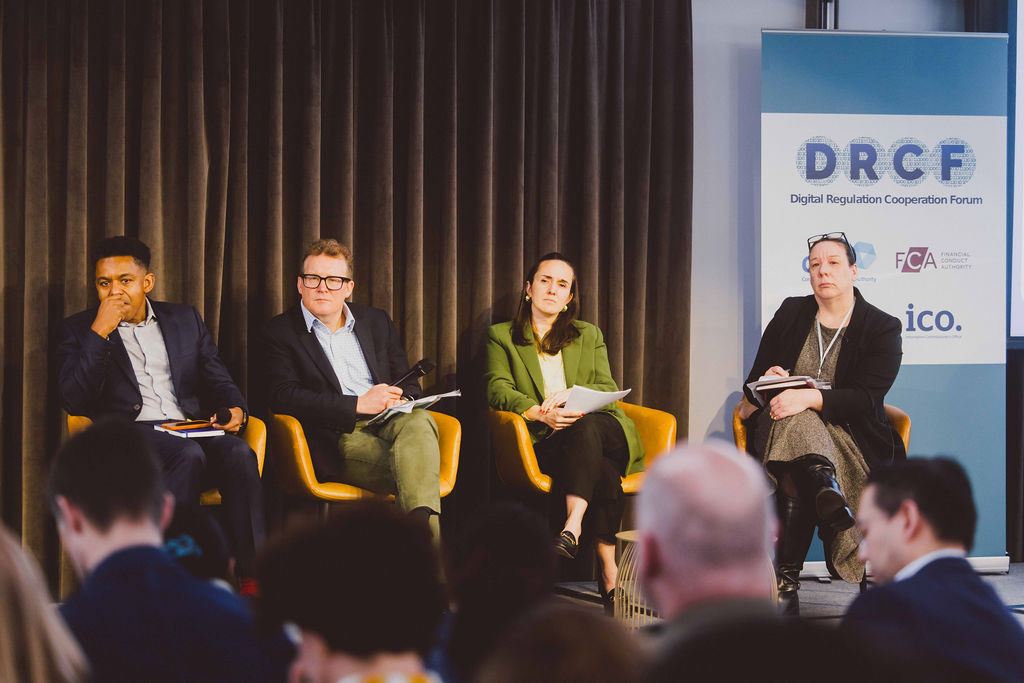 Sheldon Mills, Executive Director, FCA;Tim Gordon, Partner, Best Practice AI; Valeria Adani, Partner, Projects by IF; Sue Daley OBE, Director of Technology and Innovation, techUK
In addition, our panellists highlighted that while clear regulation is needed to ensure effective governance, organisational culture can also play a role, with organisations requiring the right skills, frameworks and motivation to apply governance effectively, beginning with design teams. AI governance should become a core business responsibility at the heart of business operations, rather than simply a compliance issue. Regulators can play a role here too, with the FCA and the ICO highlighting their use of sandbox environments for safe experimentation. Across several panels, our panellists were in agreement that governance is not merely a technical question, but a strategic, logistical and human one.
Speaking to that question, our panel on public sector adoption underscored the need for early buy-in from intended users, good communication about how and when to use tools and ensuring users have the right training and skills to evaluate and validate outputs and effectively act as the human-in-the-loop.
2. Healthy users, healthy businesses and healthy societies should be at the heart of regulatory approaches
Throughout the day, panellists emphasised their excitement about the opportunities that AI can offer businesses and individuals, whilst also cautioning against the risks that carelessly or maliciously deployed AI tools can have on individuals and wider society.
In our panel on consumer protection, our panellists discussed the ways that existing consumer harms may be exacerbated in contexts where consent, verification tools and paths to liability are not clearly defined or accessible. They also discussed the risks of societal harms from AI tools, and risks posed to individuals other than the users of the tools, which may not be caught by conventional consumer protection paradigms. There was some discussion of the merits of taking a product safety approach to digital and AI technologies. Some consideration was given to the challenges for companies in maintaining full oversight and control over the AI they deploy, and the importance of addressing questions of liability for AI harms.
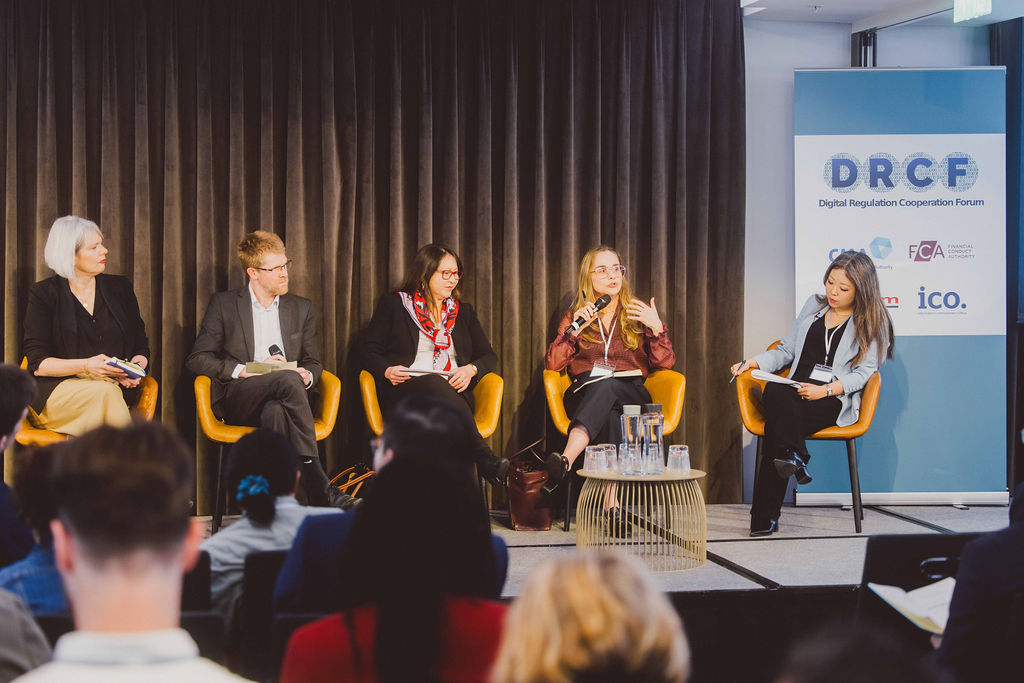
Gina Neff, Executive Director, Minderoo Centre for Technology and Democracy, University of Cambridge; Tom Collins, MP for Worcester; Karen Yeung, Interdisciplinary Professional Fellow in Law, Ethics and Informatics, University of Birmingham; Rocio Concha, Director of Policy and Advocacy and Chief Economist, Which?; Yoon Chang, Director of Strategy and Policy, Ofcom
Panellists identified their most immediate concerns for users, including fraud, misinformation and transparency as to when agents and other tools were being used. In our panel on Online Choice Architecture, panellists discussed the difficulty of evaluating what fairness looks like in hyper-personalised interfaces where what different users see shifts dynamically. For businesses, it was emphasised across several panels that responsible AI governance has become part of day-to-day operations, and that governance often fails when it is not in-step with team and organisational workflows.
Our panels also took the conversation from individual users and businesses to consider wider societal impacts, considering outcomes related to cognitive decline, data security and consent. Throughout the day, our participants emphasised the need to implement AI tools in ways that engender trust in markets and across organisations and ensure we protect the most vulnerable users from risk.
3. Regulators can learn from their own use of AI tools
A key theme starting with Kenneth Cukier’s keynote address came from the idea that regulators are not insulated from the technologies they supervise - “We shape our tools and thereafter our tools shape us.”[1] Indeed, like other parts of society, regulators stand to benefit from the time and cost-saving potential of AI tools -- while being exposed to many of the same risks. But, unlike other parts of society, digital regulators are at the same time tasked with analysing and responding to these technologies to ensure that they serve all of us well. This duality sparked many thoughtful discussions on what our own use of AI can teach us about responsible deployment more broadly, with representatives from the regulators emphasising that internal use builds technical expertise and that internal governance frameworks develop alongside regulatory policy.
Member regulators are keen to encourage growth and innovation in this technology while protecting people from harms. We understand the latest innovations, we see the opportunities and challenges that emerging technology presents and we recognise the issues that dominate the minds of industry, the public and policymakers.
4. Complex systems require collaborative solutions
DRCF member regulators are focused on solutions and collaborative progress – we are committed to learning what works through industry, academia and civil society to ensure emerging technology is deployed responsibly. DSIT stressed that they are keen to learn from regulators about best practice in adoption, and to exploit the scope for regulatory innovation to unleash growth.
Throughout the day, we emphasised that the DRCF and its member regulators remain focused on collaborative progress towards concrete solutions. In her opening message, DRCF CEO Kate Jones likened the regulatory approach to AI to a house – while we may each have our own rooms and spaces, we work together to build and maintain the complex ecosystem we all inhabit. The DRCF itself was highlighted as crucial for coordinating collaboration, making cooperation the default mode for its member regulators.
Several panellists (including representatives from our regulators) emphasised the need for cooperation and proactive engagement between regulators, businesses and the public to ensure that regulatory approaches are informed by those affected and that our work has the widest impact.
For example, in our panel on AI in Fintech, panellists highlighted how AI can accelerate data-related problem solving and improve inefficiencies across a number of use-cases. However, our panellists made clear that safe adoption should be prioritised, enabled by regular and pro-active engagement between industry and regulators, supporting responsible experimentation and broadening regulators’ knowledge of the technology and its current and future applications.
The Forum convened diverse voices from government, industry, academia and civil society to explore opportunities, challenges and potential blind spots in meeting regulatory goals. Overall, the message was clear: addressing the impacts of AI is a shared endeavour, and meaningful progress depends on continued engagement and partnership across sectors. This will be reflected in the next phase of the DRCF’s work.
Future direction
The Responsible AI Forum continues the discussions we began in 2025 and exemplifies DRCF member regulators’ commitment to continued collaboration with each other and with businesses and users across the digital markets sector. This continues into our current and future work where we will work together and engage with the public, industry and civil society stakeholders to share knowledge, ideas and impact. Throughout 2026 and into 2027, we will prioritise:
- Shared regulatory policy discussions, ensuring continued collaboration and cooperation between our member regulators
- Building closer ties with industry, academic and civil society with ongoing discussions that serve to explore the continued impacts of AI on businesses, users and society.
- Consumer protection, developing a deeper understanding of consumers’ perceptions of and approaches to using agentic AI tools, the risks and opportunities they present, and how regulation can help mitigate those risks.
- Building knowledge of AI regulatory best practice with our internal AI Audit Skill Share group, identifying areas of common interest and overlap where joint solutions can be developed.
- Hosting a third Responsible AI forum, bringing together innovators, regulators, industry and others as we’ve done this year.
The discussions we have participated in during the Forum will inform our work over the next year, as we develop our understanding of both the opportunities and risks that AI developments present and ensure we are well-placed to provide guidance and regulation that supports users and businesses and promotes responsible and innovative AI deployment.
For more on the DRCF, including its various workstreams and our future events, sign up to our newsletter via the contact form on our website or get in touch with us by email at drcf@ofcom.org.uk.
[1] This quote is often misattributed to the media theorist Marshall McCluhan, when in fact it was his contemporary John Culkin who said it. See e.g. P. Hurme and J. Jouhki, ‘We shape our tools, and thereafter our tools shape us’ (2017) 13(2) Human Technology 145.


